RefRig / Hangprinter Project
REFRIG
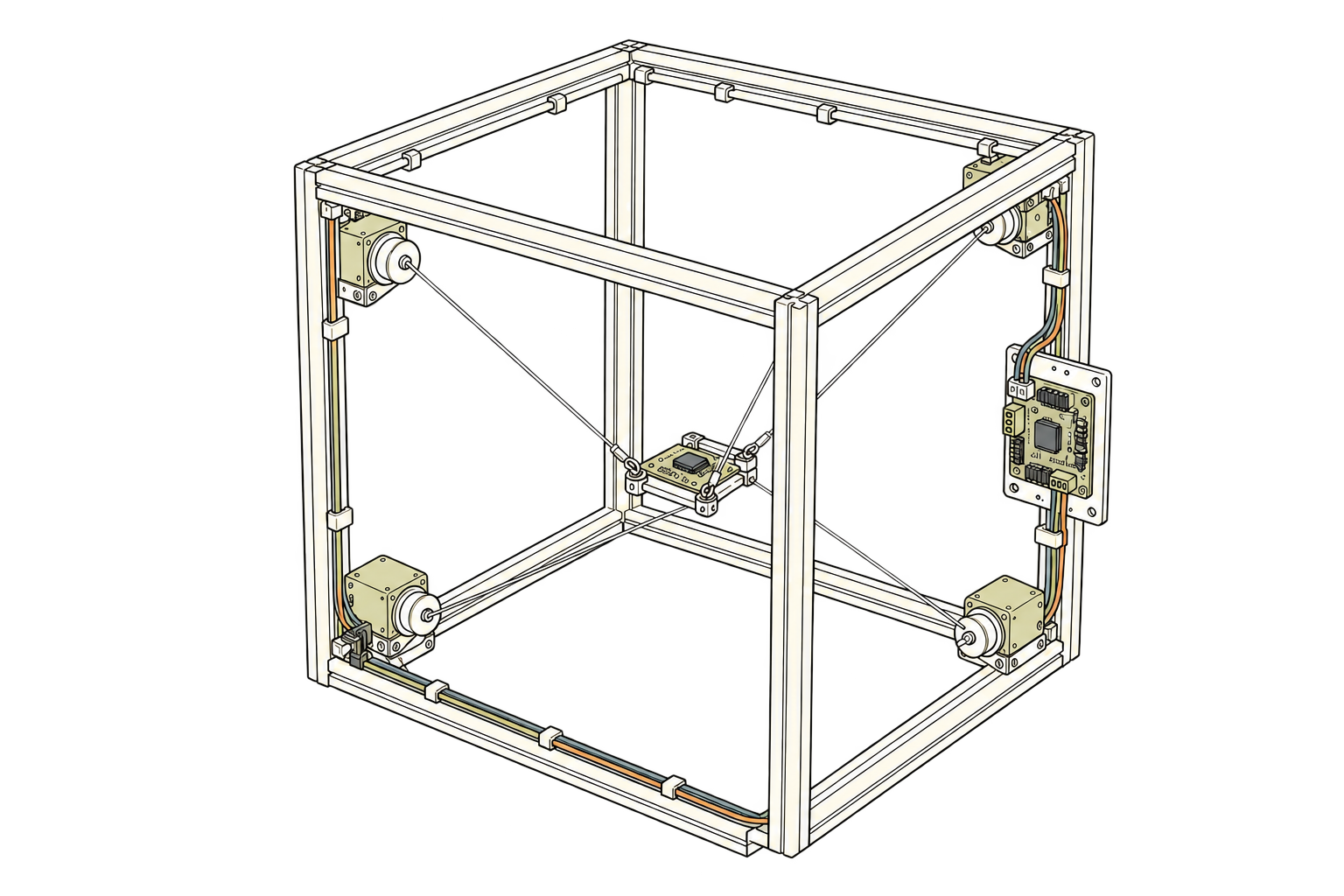
RefRig is the Hangprinter Project's desktop reference machine for hardware, firmware, calibration, diagnostics, and documentation.
01 / CONTEXT
THE LARGER PROJECT
RefRig in the
Hangprinter Project.
Hangprinter is an open-source, line-driven precision robot designed to move a tool through large volumes without a conventional gantry.
RefRig is step 2 in the Hangprinter bootstrapping hierarchy. It is intended to be the first physical build, with a known and compact setup for testing motion, calibration, firmware, RefWinches, and diagnostics.
New features should work on RefRig first. Its reproducible hardware makes configs, measurements, support logs, and simulation outputs easier to compare.
Explore HangprinterBOOTSTRAPPING HIERARCHY
RefRig is step 2 of 3.
01REFWINCH02REFRIG 03HANGPRINTER
Establish one predictable, measurable line-length actuator.
OPEN PROJECT ↗Combine reference winches in a compact physical machine.
Scale verified motion into open, large-volume fabrication.
OPEN PROJECT ↗02 / ROLE
PROJECT SCOPE
What the reference rig is for.
RefRig defines a bounded machine with a versioned bill of materials, a known-good configuration, complete instructions, acceptance tests, and a ready-built digital twin.
A documented desktop machine.
- Every builder's first physical Hangprinter build
- The first home for new features and diagnostics
- A common setup for support and verification
- A path from principles to calibration and real prints
A full-size machine.
- Not a full-size Hangprinter or general-purpose CDPR
- Not an experimental frame-development exercise
- Not a substitute for a larger machine
- Not complete until its tests and documentation are complete
03 / DESIGN BRIEF
REFERENCE REQUIREMENTS
The rig should be minimal, robust, and easily sourced. Its diagnostics should show when physical behavior and simulation results diverge.
Desktop scale
Small enough to build, use, and document as a complete machine on a desk.
A working printer
A physical machine that completes real 3D prints.
Known geometry
Defined anchor positions let calibration results be checked against a trusted baseline.
RefWinch compatible
A common frame for both buildup and no-buildup versions of the reference winch.
Rigid and standard
A robust, conventional frame that resists deformation and avoids experimental structure.
Measurable twin
Diagnostics detailed enough to compare physical behavior with the hp-sim5 digital twin.
04 / FRAME
FRAME CHOICE
A standard 300 mm printer frame.
The design brief calls for a rigid, robust, and easily sourced frame, preferably a ready-made skeleton from an established 3D printer. RefRig currently uses an LDO Voron V2.4 Frame Kit.
The extrusion grid provides mounting points for RefWinches, anchors, electronics, wiring clips, lights, cameras, and temporary sensors. The frame itself should not become another experiment.
- Frame kit
- LDO Voron V2.4
- Nominal size
- 300 mm
- Finish
- Space Grey
- Structure
- Aluminium extrusion cube
WHY THIS FORMAT
- Standard parts and square reference geometry
- Rigid enough for calibration and repeatability tests
- Existing accessories for mounting, lighting, and enclosures
- Enough space for several electronics and sensor arrangements
Status at time of writing: the frame has been assembled.
05 / STEPWISE BUILD + TEST
Build and test one subsystem at a time.
The project is structured so support questions can be routed to a specific, measurable test instead of debugging the whole machine at once.
- 01Electronics
Verify the control stack on its own.
- 02One winch
Prove a single actuator before multiplying it.
- 03All winches
Run the complete set without full machine load.
- 04Geometry
Measure and check every anchor position.
- 05Motion
Establish controlled, repeatable basic movement.
- 06Calibration
Collect data and compare physical and simulated behavior.
The ladder continues through repeatability, edge cases, and failure modes. Useful tests should leave numbers, plots, logs, or a clear pass/fail result.
PROJECT LINKS